Friday, July 18, 2025

“On Fridays” published in Thema (USA) and translated into Bahasa Melayu


“On Fridays” was published as a reprint in the Summer 2025 issue of Thema.  This was the sixth time that Thema had published one of my Malaysian-set short stories, five from Lovers and Strangers Revisited.  Years ago, I pitched an idea to The Writer about the writing of “On Fridays” based on my Story Behind the Story series, and the editor agreed and requested I follow an established format:  The Work, The Problem, The Solution, Before and After.  It was put on hold for a couple of years (my last article took four years for them to publish).  Then a new editor took over and the project fell through the cracks.  It happens.  When Thema accepted the story last year, I updated what I wrote for The Writer and resubmitted it along with the previous editors acceptance and format suggestions.  Still waiting…


THE WORK: “On Fridays,” published in the Fall 2003 issue of The Literary Review (US) and Number 19 of Frank (France)—a joint venture on Expat Writing.  Published fourteen times in six countries, originally in Female (Singapore, March 1989), then later reprinted in Cha: An Asian Literary Review (Hong Kong, 2010) and Thema (summer 2025).

THE PROBLEM: The original idea for “On Fridays” came when I lived in Penang, Malaysia working part-time as an adviser for MACEE, Malaysian American Commission on Educational Exchange.  Every Friday I would take a sixteen-kilometer taxi ride into George Town—a shared taxi with other passengers getting on and off at various locations.

From the hundreds of taxi rides that I took, I chose to create one that was representative of all those rides.  By using the senses—see, hear, feel, taste and smell—I tried to make this one taxi ride as realistic as possible by putting the reader in that taxi with me.  If they believe in that taxi ride, then they’ll believe in the story.  That it’s the “truth;” that it “happened;” that there really was “a girl;” and that I’m still “searching” for her.... Invariably my students would ask, “Have you found her yet?”

I saw this taxi as a metaphor for multiracial Malaysia, where various races lived and worked together in relative harmony.  In the story, an expat, an unnamed Westerner, becomes interested in a Malay woman sitting beside him.  She is reading a letter and crying.  He wants to comfort her, but feels self-conscious because of the other two passengers and the Muslim taxi driver.

Normally I write in the past tense, third person but chose to write this story in the present tense to give the story an immediacy, and hopefully a timeless quality…and make it linger, especially the ending, so it would seem like it just happened.  I also wrote it the first person at the expense of people assuming it’s autobiographical.  Unlike the character, I don’t paint, and the character taught English years before I did.  The effect I was going for, I felt, would be better served because I wanted the reader to closely identify with the narrator, to see himself in this, or in a similar situation, and think about what he or she would do.  This was the one story from my collection Lovers and Strangers Revisited that people would mention and relate a similar experience of their own.

When I first wrote the story, I had a lot of details describing the Malaysian sights along the way.  An editor from the UK made the comment that it read too much like a travelogue.  An editor in the US suggested that I lop off the final paragraph.  I didn’t like his suggestion, yet I felt he had a point.  Also, readers unfamiliar with living in Malaysia, a Muslim country, may question the expat’s motives, so that would need to be addressed without intrusion from the author.  Then a few matters of truth were getting in the way of the story.  Already I can hear protests, “But that’s the way it happened!”  Yes, no doubt, but to get to the essential story, the “real” story, sometimes you need to take a step back from your truth and ask yourself, does your truth serve the story, or does it hamper it?  Truth often gets in the way of a good story.

THE SOLUTION:  I cut out most of the descriptions outside the taxi that weren’t essential to the story itself, just those that highlighted that it was miserable, raining day.  With that US editor, we agreed to compromise by rearranging a couple of paragraphs at the end, to make the story more effective, so the focus wasn’t on the man’s loneliness, but on his obsession in trying to find the girl.  It was also suggested that I make the expat character single.  Him being married (like me) raised some moral issues—is he cheating on his wife?  Good advice, which I took—an example of how “facts” or “truth” can have unforeseen consequences in your fiction.

A reader, unfamiliar with Malaysia, asked me what’s the big deal if he does touch the young Malay woman in the taxi, so I worked in the character’s concern about being arrested for “outraging her modesty” with three potential hostile witnesses.  As a writer, you can’t always assume that overseas readers will understand a local concern or what is at stake.

Then I got to thinking, why doesn't he get out of the taxi at the jetty and follow her after that yearning look that she gave him (I would), and if he does, I would need to make it clear why he has to return to the taxi, for fear of losing his job, something difficult for an expat to get without a work permit.  So, I added this new scene to the story.

BEFORE AND AFTER:  Although this story had already been published in five countries and included in a collection of short stories, this revised version was accepted by Frank, a literary magazine in France, whose editor, incidentally, was a guest editor for The Literary Review for a joint venture on Expat Writing.  For me, a double surprise.  As an American living in Malaysia, I submit a story to France and it gets published in the US and France!  Later, Lovers and Strangers Revisited was also translated into French.


Speaking of translation, I recently discovered by chance that “On Fridays,” had been translated in Bahasa Melayu and uploaded a year ago for a Universiti Teknologi Mara course, from College Sidekick, which, I gather, gathers material.  They claim that they are not sponsored or endorsed by any college or university.  Did they ask me or my previous publisher for permission to translate that story?  Did they even attempt to contact me?

Makes me wonder what other stories from that collection have been translated in Bahasa Melayu?  Or even the whole book.  At one time, I thought that would happen.  Maybe it has, and I’m just unaware.  Maybe it’s time I investigate, even look at the possibility of having the collection officially published into Bahasa Melayu.

            —Borneo Expat Writer

Saturday, May 3, 2025

Encyclopedia Britannica: A Mother’s Gift Honored in Time for Mother’s Day


In Borneo, I finally found a proper place for my Encyclopedia Britannica, a gift from my mother.  I was fifteen years old when I filled out one of those mail-in cards inserted inside magazines.  One evening a knock came at the door and a salesman from Encyclopedia Britannica appeared, saying they had received a request.  My mother and my stepfather were quite baffled until I meekly admitted that I was the guilty party.

I knew at the time that they couldn’t afford such a luxury item when no one, other than me (and occasionally a brother), read.  They did know that I had good grades and that I planned to go far.  They were not thinking in terms of geography so it never crossed their minds that I would travel to 36 countries and live in Malaysia for forty years (21 years in West Malaysia, Penang; 19 years in East Malaysia, Kuching).  They also knew that I planned to go to college, not that they could afford that either. 

They invited the salesman, who strategically didn’t call ahead of time, inside our house and sat with him at the dining table and listened to his sales pitch and how much this was going to cost them.  Trying to keep a low prolife, I circled behind them now and then, wondering how all this was going to play (or pay) out.  To my utter astonishment, my mother and stepfather agreed, and the entire set of Encyclopedia Britannica was mine.

Neither was I punished nor reprimanded, other than mildly—they did strongly advise me not to fill in any more of those cards inserted inside random magazines…

My mother, which I just rediscovered, had written inside the cover of Volume One: 

           The owner of all these books is Robert J. Raymer, June 1972

After attending Miami University and spending three months backpacking in Europe, I moved from Newark, Ohio to Boulder, Colorado, and the encyclopedias came with me.  They also followed me to Madison, Wisconsin where I began to write using a typewriter.  In those pre-computer, pre-Internet days, those encyclopedias did come in handy.

Then I moved to Penang, Malaysia, bringing my typewriter and encyclopedias with me.  I consulted them regularly.  It was part of my job as a writer—there was always something to investigate or research.  One child (two actually) was born in Penang and the other in Kuching, Sarawak on the island of Borneo.  Future users of my encyclopedias, which they mostly ignored.

Over the years the encyclopedias resided (or took up space) in various boarding rooms, apartments, condos, and houses.  If space was an issue, sometimes under my bed or in various offices upstairs and down, in storage boxes, and on a bookshelf nestled inside a storage closet for relatively easy access.  As my Encyclopedia Britannica began to age, some of the numbers and letters on the spine became too faint to see, so I used white-out.  I know, tacky. 

Recently, our second child graduated from secondary school, so after removing various school-related boxes out of the way, voilĂ , a space became available that I thought would be just perfect—perfectly suitable for my Encyclopedia Britannica.

Now all I had to do was convince my wife that these fifty-year-old encyclopedias that I hardly touch these days deserve a fitting location in honor of my mother who passed away in 2019.  Thankfully (perhaps reluctantly on her part), she agreed.  For how long, I don’t know.  For now, they are in place in time for Mother’s Day—for the mother who presented me that set of Encyclopedia Britannica when I was just a kid, obviously going places.  Thank you for investing in my future as a writer.                                                            

            —Borneo Expat Writer

Thursday, April 17, 2025

Writing Excerpts and Entering James Jones First Novel Fellowship


After blogging about taking two years to rewrite six novels, I received some nice comments from an editor at Shenandoah about an excerpt I had submitted.  She suggested, however, that I submit an excerpt from the beginning of the novel—that way the reader could get acquainted with the characters and the setting as the ‘story’ develops.  Good advice, I thought.  Excerpts from the middle or near the end of the novel might be harder for them to stand on its own without the necessary character developments or backstories.  That would depend on the novel or its structure.

While contemplating the beginning of the novel as a stand-alone excerpt, I suddenly realized (or forgot) that the James Jones First Novel Fellowship deadline was near—for those who have not published or self-published a novel.  Since they require the first fifty pages of the novel and a synopsis/outline, I decided to take a closer look at those fifty pages (even going through each chapter three times, then those fifty pages three more times as I did before).  I figured since the first fifty pages (or the first three chapters) is what I normally submit to agents, I’ll benefit from that, too.


After submitting my entry, I then created that new excerpt for Shenandoah.  From chapters One-Four, I cut out the parts not relevant to the ‘story,’ though relevant to the novel, thus cutting the length down from 11,276 words to less than 8,000 words, their maximum length.  I titled the excerpt, “Ask Questions Later.”  By then, unfortunately, Shenandoah’s submission period had closed (they had reached their quota early and wouldn’t reopen for several more months.)  So, I had to find another market that accepted novel excerpts—so long as they could stand on their own.  Fortunately, I found several.

Years ago, I used to do this with my first Penang-set novel.  Parts of the five chapters have been published fourteen times in six countries, including the US, UK, and Australia.  I had less success with excerpts from other novels.  Maybe I hadn’t tried hard enough to market them or gave up too soon or failed to update them after a rewrite…

I’m now considering rewriting the first fifty pages of all six novels before the year is out (half way through, actually) and seeing what I can fashion into excerpts that can stand alone. Hopefully the excerpts can attract interest in the novel itself as I continue submit to agents.  So far, I’ve resisted self-publishing, despite some amazing success stories, or co-publishing, despite one enticing offer.  (That first novel could’ve been published twenty odd years ago in Singapore!  Regrets, maybe.)

Plenty of novels, of course, have grown from published short stories (and plenty of unwritten novels have died after that first chapter since it had nowhere to go, even though it worked as a short story).  Plenty of novels have also spawned excerpts or short stories as well.  It goes both ways.  As I writer, you got to do what you can with your fiction, take those necessary steps that can lead to publication and move you closer to where you want to be.

              —Borneo Expat Writer

 My interviews with Malaysian writers:

Ivy Ngeow author of Cry of the Flying Rhino, winner of the 2016 Proverse Prize. 
Golda Mowe author of Iban Dream and Iban Journey
Preeta Samarasan, author of Evening is the Whole Day, finalist for the Commonwealth Writers Prize 2009. 

Chuah Guat Eng, author of Echoes of Silence and Days of Change.

Malachi Edwin Vethamani, author of Complicated Lives and Life Happens


Sunday, April 13, 2025

Catching Up: Reading a Backlog of Short Stories…

I admit I had been putting off reading several collections of short stories.  I kept them on a separate shelf divided by those I’ve read, those I haven’t.  A couple of months before the end of last year, I committed myself to plowing through them once and for all.  I began with Nadine Gordimer’s anthology, Telling Tales with award-winning writers like Gunter Grass, Gabriel Garcia Marquez, Margaret Atwood, Salman Rushdie, and Arthur Miller. 


Then came Bobbie Ann Mason’s Shilo and Other Stories; Joanne Greenberg’s Rites of Passage (read the first story a couple of decades ago, liked it, but never got around to reading the rest); Isaac Asimov’s Nine Tomorrows (signed copy, though second hand.  “The Last Question” blew me away—never saw that great ending coming!)  Later, I came across an interview where Asimov stated that was his favorite story.

Next, I read Lorrie Moore’s Birds of America (I sort of met her in Madison, Wisconsin before I knew who she was, other than a writer making photocopies, before I began writing my own stories.  Never on a first name basis, though; a missed connection).  Jhumpa Lahiri’s Unaccustomed Earth (loved her first collection so don’t know why it took me years to read this.); Alice Munro’s The Love of a Good Woman; The Stories of John Cheever (the big red hard cover that won the Pulitzer Prize); The Collected Stories of Jean Stafford (another Pulitzer Prize winner); and Thomas Pynchon’s Slow Learner (his early work).      


I was just getting warmed up.  I then read three anthologies:  American Short Story Masterpieces edited by Raymond Carver and Tom Jenks; Norton Anthology of Short Fiction, third edition, R.V. Cassill; and Anthology of American Short Stories edited by James Nagel.  These last three alone had combined pages of 3,038, which may explain why I kept putting them off.  Some of the stories were repeats of what I had read earlier or years before.  Many of those, I reread.  Others I had never heard of, nor the writers (some brilliant stories, too).  I enjoyed the sheer variety of great, well-written short stories, some dating back 170 years.

Some stories you read once and stays with you a lifetime like an Edgar Allan Poe story, or Jack London’s “To Build a Fire.”  Haunting stories about life and death and survival, like escaping capture in the desert and finding yourself sharing a cave with a panther as in HonorĂ© de Balzac’s “A Passion in the Desert.”

So, the next time you have the urge to pick up a collection or an anthology of short stories, do so.  You won’t regret it.  In fact, it may inspire you to write one of your own, even set in your own country like Malaysia—a great story, no matter where it is set, is a great story…. I began writing my own set-in-Malaysia stories a couple of years before I decided to move here for good.  One of the stories, “On Fridays,” after rewriting it (rewriting all my stories), is appearing this summer, as a reprint, in Thema (USA).

Next up, or maybe next decade, The Complete Works of William Shakespeare which I bought four decades ago when I was still a bachelor living in America before I began to write...

        —Borneo Expat Writer

 My interviews with Malaysian writers:

Ivy Ngeow author of Cry of the Flying Rhino, winner of the 2016 Proverse Prize. 
Golda Mowe author of Iban Dream and Iban Journey
Preeta Samarasan, author of Evening is the Whole Day, finalist for the Commonwealth Writers Prize 2009. 

Chuah Guat Eng, author of Echoes of Silence and Days of Change.

Malachi Edwin Vethamani, author of Complicated Lives and Life Happens

Monday, September 16, 2024

So, is your novel Literary? Commercial? Upmarket? Book Club?

Whenever I submit one of the six novels that I recently rewrote in trusting the process to an agent, I’m often asked, via online, what is the category?  This in not so much about genre (romance, horror, sci-fi), but about marketability.  Is it Literary?  Commercial?  Upmarket?  How about Book Club?  Well, that depends (and depends on which book)… One day I’d say, literary, then the next time I’d lean more toward commercial, or I’d think (wishful thinking, perhaps) maybe it’s upmarket… 

I used to know, but a lot has changed in the marketplace in the last ten to twenty years.  Even within Malaysia/Singapore.  Suddenly, I’m not so sure of today’s distinctions between literary, commercial, upmarket, book club.  Some seem to overlap.

To re-educate myself I did some digging and found this informative article by Louise Tondeur of Jerico Writers:  Upmarket Fiction: Everything You Need To Know.”  She did a great job defining what upmarket means (comparing it to literary and commercial); gives some examples, and shows how to achieve that in your own writing, and offers tips.  Her other links seem useful, too.

The next time someone (an agent, a friend) asks about the book you’re working on (not just the genre or the plot, but its market), you’ll feel more confident in your answer.  If in doubt, get educated!  Education is ongoing no matter how long you’ve been writing or how many books you’ve written.  Markets change, so does the marketability of your book.  In fact, might be a good idea to think about your market before you write your next book.  Ask yourself:  Who am I writing this book for?  Who do I see reading it?  If it’s just you (and others like you) or for someone special—great, start there.  Later, you can add readers along the way…

            —Borneo Expat Writer
Sunday, August 25, 2024

“On Fridays” to be published in Thema (USA)


As I wrote in a recent blog, every few years I get this urge to rewrite the 17 stories from Lovers and Strangers Revisit­ed.  The first story, “On Fridays” has just been accepted by Thema as a reprint in their A New Routine issue (summer 2025).

After submitting another story, I thought, why not try “On Fridays” as a reprint since it fit the theme?  I didn’t know if they accepted reprints—it was previously published in The Literary Review in 2003, which I acknowledged in the cover letter.  Figured I had nothing to lose.

When I received an email from Thema, the subject line stated, “Acceptance,” so I knew that it contained good news.  I forgot which story I had sent them.  I was even more surprised when it was “On Fridays.”  I had completely forgotten I had sent it as a reprint.  I double checked to make sure that I had in­formed them.  As a reprint, the story will earn less than it would have as an original story, but I’m not com­plaining.

So now the stories from Lovers and Strangers Revisit­ed have been (or will be) published 83 times in 12 coun­tries (12 stories in USA and UK).  Not bad, which is exactly why I get this urge every few years to rewrite these stories, because you just never know when another one will be published.

This is also the reason I spent two years rewriting six novels (and two collections of stories and a play), because you just never know.  You must trust the writing process and keep submitting your work and keep your fingers crossed that an agent or an editor will say, hey, this is not bad…in fact, it is quite suitable for our present needs…

            —Borneo Expat Writer

Sunday, August 4, 2024

Faulkner-Wisdom Novel Awards—2024 Finalist for Novel: One Day Among the Ruins: A Lesson in Love and Friendship


One Day Among the Ruins:  A Lesson in Love and Friendship, one of the six novels that I re­wrote between 2022 and 2024 and blogged about, was named a finalist by The Pirate’s Alley Faulkner Society’s The William Faulkner – William Wisdom Creative Writing Competition.


This was also my COVID-19 pandemic project that I finished in 2022 then rewrote this year for the competition.  Here is the pitch I’ve been sending to agents:

One Day Among the Ruins:  A Lesson in Love and Friendship (111,985)

An American backpacker and a British expatriate widow experience a lifetime in one day at Pompeii and a night in Naples.  Eat, Pray, Love meets The Graduate meets Indecent Proposal

One autumn day in 1978, between college and career, Mad­dox, an Ameri­can back­­pack­er in a funk about missing a love-interest in Rome, meets Alexis, a middle-aged British widow teach­­ing literature in Malaysia.  Their unlikely, cross-gen­­erational friend­­­ship is forged among the ruins of Pompeii as they share their per­son­al trage­dies and troubled fami­lies, fill­ing a void in each other’s lives.  Yet who is the teacher…who is the stu­dent?  Eag­er to learn more about her near-death ex­peri­ence, Maddox dares Alexis to join him for pizza in Na­ples.  Later he dares her to dance and dares her to ac­cept an un­usual birth­day present, teach­ing him about love.  For Alexis, the dare feels like an opportunity to re­cov­er some love­less years, if on­ly she could for­get about the gut-wrench­ing di­lem­ma that she had to face in the waning days of her son’s life.

Alexis and Maddox came from different generations, different worlds:  Alexis, born in India, the pam­pered daughter of British Raj officer, mar­ried off young on­ly to be­come a wid­owed war bride at eigh­teen, then a survivor of the London Blitz, while Mad­­dox hails from a dys­func­tional, blue-collar Midwestern family with multiple divorces and para­sitic step­sib­lings.  One thing they do share, other than their company, is their brutal honesty.

 People—all of us, I supposetend to see the world in black and white,” Alexis in­forms him.  “Most of life falls in­to a gray realm.  Rarely are there right an­swers.”  She later adds, “For both of us, this was our journey that we had to make…to find our­selves in Pom­­peii—one the teacher, the other, the student.  Only God knows which is which.  In life, as you will dis­cover, each of us teaches and learns, often at the same time.”

Having backpacked three months in Europe in 1978 (and a month in Italy in 1985), hav­ing visited Pompeii (with journal, guidebook, and Bulwer-Lytton intact), having lived for twen­­ty years in Pe­­nang as an expatriate (like Alexis), I have tried to show how that one day—a time cap­sule, real­ly—can resonate in unexpected ways in world events being played out to­day.

              —Borneo Expat Writer

My interviews with other Malaysian writers:

Ivy Ngeow author of Cry of the Flying Rhino, winner of the 2016 Proverse Prize. 

Golda Mowe author of Iban Dream and Iban Journey

Preeta Samarasan, author of Evening is the Whole Day, finalist for the Commonwealth Writers Prize 2009. 
Chuah Guat Eng, author of Echoes of Silence and Days of Change.

MalachiEdwin Vethamani, author of Complicated Lives and Life Happens.


Monday, March 25, 2024

Trust the Novel Writing (and Rewriting) Process


Two years ago, in March of 2022, after finally completing a sixth novel (set in Pompeii about an unusual friendship be­tween an American backpacker and a British expatriate widow re­siding in Malay­­sia), I got the idea to rewrite a couple of my other novels (to give them a fighting chance in a tight US/UK market).  While I was at it, I did all five novels, plus two col­lections of short stories (in­clud­ing Lovers and Strangers Revisit­ed that I blogged about), and a play, a comedy based on the short story “Neigh­bors”

I knew that a quick read wasn’t going to do them justice, so I decided to give each novel what I came to call the 9X treatment.  First, after printing them out, I would line edit each manu­script 3X (three times)—in black, in blue, and in red.  Then on the com­puter, I would go through each chapter 3X—making additional corrections and tightening the writing by cutting and rearranging sen­tences, paragraphs.  (Never assume your writing is good; assume you can make it better!)

Then for the final 3X, I would go through each manuscript beginning to end.  The first pass is straight forward and gives me a good feel for pacing, structure, chronological order, inter­nal logic—is it working or not?  For the second pass I would start with the last chapter, then the next to last chapter, working my way to the first chapter.  Editing chapters out of sequence is power­ful.  It makes you think…wait, did I mention this detail earlier; then double check those early chapters and make the necessary changes.  A good way of catching those errors of omissions!

If I add new details at this stage, I would immediately go back and reference those details, if neces­sary, in the earlier chapters (lest I forget later).  Of course, I would do the same while editing the manu­scripts in var­ious colors, scribbling in my notes and reminders to add in or move around various para­graphs or a shift a scene to a more effective lo­ca­tion.  Then I would go through the manu­script one more time from beginning to end to com­plete the 9X process.  For the short stories, since each story is complete within itself, I would stop at 6X. 

Early during this novel rewriting process, I got a great idea for a seventh novel.  Not want­ing to be distracted, I began shoveling notes (and eventually note­books) into a loose folder.  By mid-2023, I added my Pompeii novel back into the mix to help cut the length and improve it with fresh eyes, impressed by what I had accomplished thus far with the other novel re­writes.

I also created a progress chart for all eight manuscripts since their progress ov­er­lapped, and would then check off each completed step in the 9X process.  No skipping steps along the way just because no one is look­ing!

True, it was a lot of work.  It's also a nice feeling knowing that I followed through the entire proc­ess, thus keeping my commitment to myself.  When I started, I didn’t think it would take two years!  Nor had I planned to do all five novels, let alone redo that sixth novel, plus both collection of stories and that play that had been sitting idle for nearly a dec­ade.  I kept think­ing, while I’m at it…

And while I’m at it, I’ve started a new progress chart for 2024 and the remainder of this decade (and the next—I’m being ambitious!) for future novels, beginning with that seventh novel, having accumulated over 400 pages of notes these last two years.  Plus, I have several previous novels on hold for one reason or another, some with com­plete rough drafts; others, a third of the way through the first draft; or with hundreds of pages of notes already in the computer, including sequels to the other six novels.

Itching to get started, I’ve already begun writing that novel number seven.  In the meantime, I’m hoping one of these six re­written novels will open the door for the others, making all the hard work pay off.  Or maybe it will be this seventh novel… You have to trust the novel writing (and rewriting) process.

       —Borneo Expat Writer

 My interviews with other Malaysian writers:

Ivy Ngeow author of Cry of the Flying Rhino, winner of the 2016 Proverse Prize. 
Golda Mowe author of Iban Dream and Iban Journey
Preeta Samarasan, author of Evening is the Whole Day, finalist for the Commonwealth Writers Prize 2009. 

Chuah Guat Eng, author of Echoes of Silence and Days of Change.

Malachi Edwin Vethamani, author of Complicated Lives and Life Happens.


Thursday, February 1, 2024

“On Fridays” UiTM Google Meet That I Almost Missed!


May of last year, I was up at 5:15 a.m. to get my son off to school.  Not feeling well (lack of sleep, perhaps), I went back to bed.  A phone notice woke me up, informing me that my story “On Fridays” from Lovers and Strangers Revisited, which I recently rewrote and blogged about, was being discussed in a Collaborative Teaching at Universiti Teknologi MARA or UiTM—Penang (Bertam campus), led by Associate Professor Dr. Mohamad Rashidi Pakri of USM (discussing the literary aspect of the story) and Nazima Versay Kudus of UiTM. 

Previously, during Covid lockdown, I had been invited by Nazima to join Google Meet to answer questions about my short story "Neighbours" also from Lovers and Strangers Revisited for her Faculty of Health Science students.  This time around, since it involved about sixty students from several classes from Health Science, who are learning about narrative writing, it was more practical to record and share the session among the students than to get them all together at one time, even online.

Surprisingly, I had not been forewarned, or was I a last-minute inclusion—hey, let’s wake up Robert to see if he’s available!  Either way, I was too late for the discussion, but I did manage to join the Q & A session.


“On Fridays,” the first story from Lovers and Strangers Revisited has been published over a dozen times in seven countries.  In 2003, it appeared in The Literary Review (USA) and Frank (France) in a joint publication.  I had sent the story to the editor of Frank, unaware that he had been asked to be the guest editor of The Literary Review, so he chose “On Fridays” for their joint issue on Expat Writing.  The story, about an expat living in Penang, Malaysia who sits beside a crying woman in a taxi, later appeared as a reprint for Cha: An Asian Literary Journal in 2010.  Since then, the story had been revised several times in my effort to finally get it right… 

I would like to have listened in the session, to hear what the students thought of the story since they would be freer to discuss it without the presence of the author—for fear of embarrassing themselves or offending him—so why did we have to read that stupid story in the first place?  It nearly put me to sleep!  Hopefully, no one said that or felt that way!


By the time I came on board, or online, (freshly showered and wide awake) some students may have already left (is he coming or not?)  The questions they did ask me were straight forward.  Why did he, the unnamed first-person character, feel com­pelled to hold her hand instead of just speaking, “Hi, how are you?”  Was it im­portant that she wore traditional clothes?  Did the story really take place?  Was it a true story?  More than once, in the past, I had been asked, “Have you found her?”  “Are you still looking for her?” Many of these ques­tions I had discussed in the Story Behind the Story (which I wrote for all seventeen stories for the MPH publication), about how the story came to be written, how the story evolved after its initial publication, what significant changes I made to the story (and why) that led to subsequent publications overseas… 

Having wrote the story in 1988 (first published in the March ’89 issue of Female in Singapore), I feel honored that the story “On Fridays” is still being taught in 2023, 35 years later, and it still resonates with university students who can identify with the characters, even a lonely expat inside a share taxi on a rainy day sitting beside a crying Malay woman reading a letter on blue paper…

       —Borneo Expat Writer

 My interviews with other Malaysian writers:

Ivy Ngeow author of Cry of the Flying Rhino, winner of the 2016 Proverse Prize. 
Golda Mowe author of Iban Dream and Iban Journey
Preeta Samarasan, author of Evening is the Whole Day, finalist for the Commonwealth Writers Prize 2009. 

Chuah Guat Eng, author of Echoes of Silence and Days of Change.

Malachi Edwin Vethamani, author of Complicated Lives and Life Happens.


Thursday, January 11, 2024

Rewriting Lovers and Strangers Revisited


Every few years I get this urge to rewrite the 17 stories from Lovers and Strangers Revisit­ed.  No doubt that seems silly and a waste of time for most writers since the book has already been published.  Had I not done so, it wouldn't been published a second or a third time!  Originally published in Singapore as Lovers and Strangers (Heinemann Asia,1993, Writ­ing in Asia Series), I revisited the stories in 2005 when a Malaysian lecturer requested to use the collec­tion for a course on Malaysia and Singapore literature.  The book—after consulting with an editor and going back to the original inspiration for each story, vis­it­­ing many of the ori­gin­al settings and over­hauling the stories, adding new scenes, back-stories, and endings—was repub­lish­ed as Lovers and Strangers Revisited (Silver­fish Books).


In 2008, a third revised ver­sion with two additional stories was published by MPH, which I wrote about in a blog about publishing in Malaysia and Singapore, that later won the 2009 Popular-The Star Reader’s Choice Awards and was translated into French.  To complement the MPH edition, I wrote a blog series, The Story Behind the Story, about the devel­op­ment and the sig­nif­i­­cant changes of each story that led to their various mag­azine/lit­erary journal publica­tions—often used as writ­ing/teaching aids in schools, colleges, and uni­ver­sities.  The main char­acter from the story “Neigh­bors”  was featured by an expat teacher in the New Straits Times, “Are You Mrs. Koh?” 

So why revise the stories again?  I’ve always felt that Lovers and Strangers Revisited, based on its publishing track record, deserves a wider audience both inside and outside of Ma­lay­sia/Singapore.  For example, the collection is still available in French by Editions GOPE as Trois autres Malaisie.  In fact, the publisher will be exhibiting the collection along with his other Malaysian titles at a French book fair in Kuala Lumpur on 24 March 2024, which should translate into more sales!.


So far, thanks to rewriting those published stories, the individual stories have been published 83 times in 12 coun­tries (12 stories in USA and UK); taught in Malaysian secondary school literature for six years (“Neigh­bors”), as well as in Cana­da and USA (Ohio University); and several stories have been taught for years in various Ma­lay­sian universities and private col­leges.  Film stu­dents at Ohio Univer­sity found the original collection in their library, came to Malay­sia, and filmed, “Home for Hari Raya.”  

Maybe because of this persistent belief that these stories (individually and as a col­lec­tion) are still relevant—they are still being taught in Malaysia as of May 2023 and are still being published in the USA (“The Stare” appeared in Thema, Spring 2021,and "On Fridays" will be out in 2025).  As I began editing again (clarifying details, cutting need­less words or phrases, tightening the writing), I could see significant improvements in each story.

Also, the process feels like a trip down memory lane, both as a writer and as an expatriate living in Malay­sia.  “Mat Salleh,” for example, was my first published story, a non­fiction short story, 28 January 1986 (New Straits Times) and my first published story in the UK (My Weekly).  "Teh-O in K.L." was my first published short story is USA (Aim). The other stories, all published but one, are all loosely based on my early ex­peri­ences or on my ob­­ser­va­tions of kam­pong and modern-day life in Malaysia.  Not all the memories are good—a failed mar­riage for me (“Dark Blue Threads”) and a neighbor com­mitting suicide (“Neighbors”); nevertheless, these stories are my Malaysian roots, so to speak, having lived in Penang as an expatriate for twen­ty-one years and taught creative writing at USM for ten years, before moving to Sarawak to grow new roots.

The real payoff, of course, is that these revised stories now have a chance for future publica­tions in the US or UK or Australia or elsewhere—the main reason I do it.  Or the collection, fingers crossed, is republish­ed to a wider audience.  Or the play that I added as a bonus, “One Drink Too Many,” a comedy adapted from the short story, “Neigh­bors,” is produced in Malaysia or Singapore.  Preferably, all three!

What helps me to keep the faith in Lovers and Strangers Revisited (and the individual stories) is rereading the MPH back-of-the-book reviews and other review snippets that I include while marketing the collection to agents and other publishers: 

MPH Publisher’s synopsis and reviews from the back of the book:

In this collection of 17 stories, Robert Raymer portrays the traditional in modernity, the unexpected in relationships both familiar and strange, the recurring theme of race even as contemporary Malaysia finds ways to understand its multicultural milieu.

In the title story, a selfish writer gets more than he bargained for when two former lovers haunt him in more ways than one. In another story, a man's loneliness turns into obses­sion when he shares a taxi ride with a Malay woman. A Clark Gable lookalike is a bar­rister wannabe with a shocking secret and gossipy neighbours reveal more about them­selves than the man who commits suicide. Elsewhere, expats cross the border to Had Yai to experience a good bargain in the Thai flesh trade before going home to their wives in America.

In this republished edition of Lovers and Strangers Revisited, Raymer's snapshots of scenes from various walks of life provide an insider-outsider view on love, family and culture, and urges a second look at ourselves in the mirror of self-awareness.

Praise for Lovers and Strangers Revisited

'Raymer not only writes from his own viewpoint as a foreigner and observer, but also delves into the minds of desperate Malay woman, a young Indian girl, an adulterous Chinese couple, and an old Chinese man who survived the Japanese occupation... He has an uncanny ability to hold a mirror up to the people of his adopted country, not as a for­eigner but as one of us. His stories are full of personalities that you know, you work with them, or live next door to them, or eavesdrop on them at the kopi tiam.' The Borneo Post

'This account ("On Fridays") of a crammed ride with strangers in a taxi may well stand as a metaphor of Raymer's own experience of living among Malaysians... He imbues each of the characters in his stories with a realistic, genuinely believable voice even as he tempers it with the valuable perspective of an observer.' New Straits Times

'Raymer gives a lushly and rich and multi-layered rendition of the Malaysian way of life as colored and influenced by his own experiences from his twenty years as an expat here... These stories are some of the few authentic portrayals of the inner workings and inner plays of the average Malaysian's life in all of its robustness and unique cultural settings.' The Expat

A little ego boost for sure, something all writers need now and then.  Also, it’s good to touch base, like stretching before exercising.  Awfully glad I rewrote those stories.  Now that 2023 is over (having rewritten eight bookssix novels and two collections of storiesin two years), I’m ready to embark on new writing projects for 2024 and beyond... 

—Borneo Expat Writer

 My interviews with other Malaysian writers:

Ivy Ngeow author of Cry of the Flying Rhino, winner of the 2016 Proverse Prize. 
Golda Mowe author of Iban Dream and Iban Journey
Preeta Samarasan, author of Evening is the Whole Day, finalist for the Commonwealth Writers Prize 2009. 

Chuah Guat Eng, author of Echoes of Silence and Days of Change.

Malachi Edwin Vethamani, author of Complicated Lives and Life Happens.


Tuesday, October 10, 2023

Being Seen on TV by a Friend

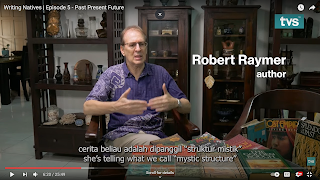
“You’re on TV!” my wife told me over the phone, calling from a Toyota dealership where she was having her car serviced.  A friend of hers had texted that she was watching me on TV.   I soon realized that it was a repeat of the Past Present Future Episode 5: Writing Natives episode on TV Sarawak that featured Golda Mowe, author of such novels as Iban DreamIban Journey and Iban Women that I had blogged about.


After interviewing Golda a few years ago, I had been asked to take part in a docu­men­tary about her writing life.  The filming for my part was done at my house, which made it convenient.  Unfortunately, I missed the actual program but I was glad that at least someone I knew watched it (or a at least a repeat version of it).


I told my wife to let her friend know that I would be available for autographs.  I’m still waiting…

      —Borneo Expat Writer


My other Interviews with First Novelists:  

Ivy Ngeow author of Cry of the Flying Rhino, winner of the 2016 Proverse Prize.
Preeta Samarasan, author of Evening is the Whole Day, finalist for the Commonwealth Writers Prize 2009.
Chuah Guat Eng, author of Echoes of Silence and Days of Change. 

Also, Malachi Edwin Vethamani, author of Complicated Lives and Life Happens.

Five part Maugham and Me series

Trust the Novel Writing (and rewriting)Process